
Prehistoric mathematics
The Ishango bone, found in what is today part of the Democratic Republic of the Congo and dating back 20,000 years, may contain some of the earliest evidence of mathematical thought.
Learn widely
The Ishango bone, found in what is today part of the Democratic Republic of the Congo and dating back 20,000 years, may contain some of the earliest evidence of mathematical thought.
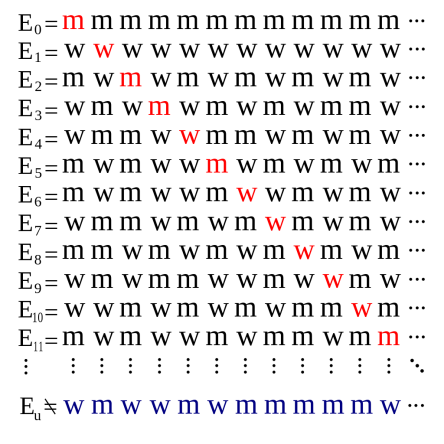
The set of natural numbers is infinite: 1, 2, 3…. The set of real numbers is also infinite: 0.1, 0.11, 0.12, 0.2… but it’s larger than the infinity of natural numbers. Georg Cantor devised an elegant argument to prove these different infinities.
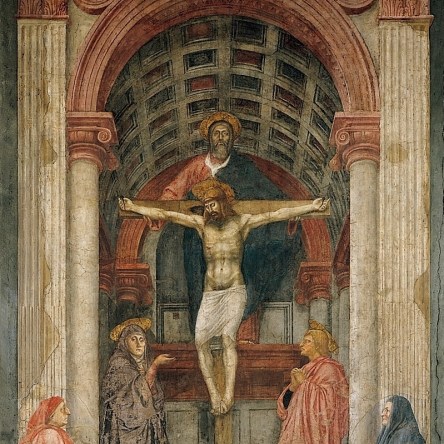
Masaccio’s Holy Trinity is possibly the earliest surviving work of art to use a single vanishing point. His work and that of Brunelleschi triggered a Renaissance explosion of mathematical perspective in art.
Masaccio’s Holy Trinity is possibly the earliest surviving work of art to use a single vanishing point. His work and that of Brunelleschi triggered a Renaissance explosion of mathematical perspective in art.
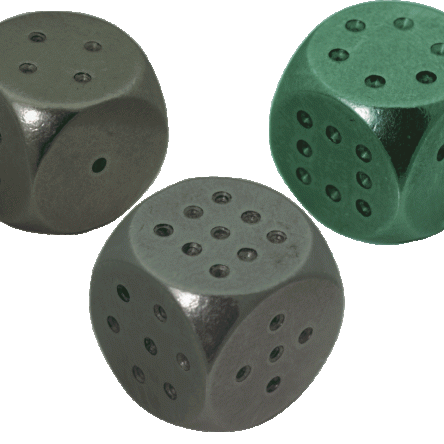
Consider three special dice: A, B, and C. On a fair roll, A is more likely to beat B. B is more likely to beat C. But C is more likely to beat A. These are nontransitive dice.

In 1997, professor of mathematics and crochet enthusiast Daina Taimiņa found a way to join those two passions in order to craft durable sections of hyperbolic surfaces.

Consider a medical test for a disease suffered by 1% of the population, which has a 5% “false positive” error rate. If you test positive, what are the chances that you are actually ill? In fact, it’s less than 17%.

The Indian mathematician Mādhava was the first to use infinite series to calculate pi, some time around 1400 CE.

According to a popular myth, the solution of a 64-piece Tower of Hanoi puzzle will herald the end of the world.
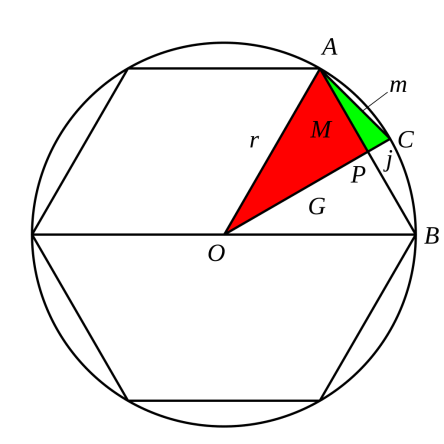
The closest approximation of Pi for nearly a thousand years was calculated by Chinese mathematician Zu Chongzhi around 480 CE, using an algorithm developed by Liu Hui.

Take a cone, sphere, and cylinder of equal height and radius. The volume of the cone plus the volume of the sphere is equal to the volume of the cylinder.
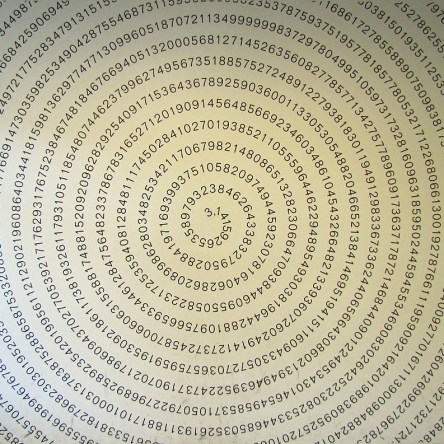
Within the first thousand digits of pi there are six nines in a row. This should not be a surprise.
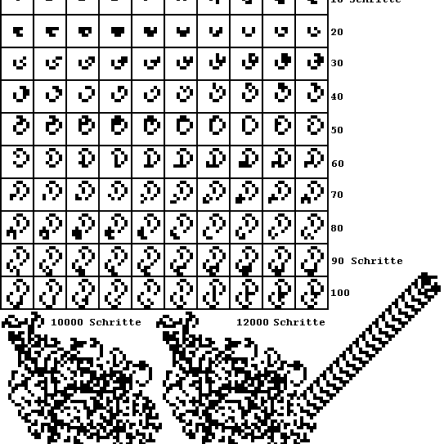
The cellular automaton Langton’s Ant follows just two simple commands, and in doing so moves in turn from symmetry to chaos to implacable order.

“One. A Poem. A Raven. Midnights so dreary, tired and weary, silently pondering volumes extolling all by-now obsolete lore.” The beginning of a short story that also encodes the first 3835 digits of pi.

If you want a job as a programmer, you need to know how to fizz buzz.
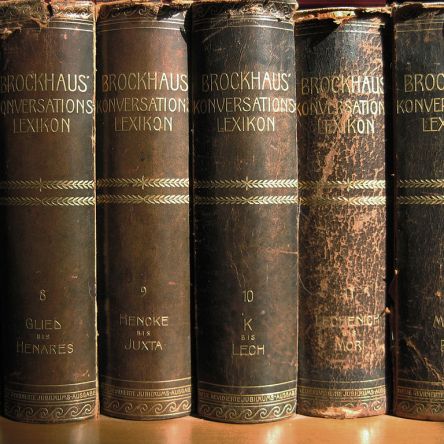
In 1945 the linguist George Zipf observed two strange word frequency phenomena: the longer a word is, the less common it is; and the most common word is used twice as much as the second most common, three times more than the third.
 The Generalist Academy